For a low-consequence replacement part, choose between 3D printing and CNC machining by the feature that must work, the material's service conditions, and the geometry each process can actually make. Printing is useful for checking an uncertain shape and for forms that are awkward to reach with a cutter. CNC machining is useful when the required features are accessible in suitable stock. Neither process, by itself, proves that a replacement is safe or fit for service.
The useful starting question is not which machine is already on the bench. It is what the missing component must reproduce: a mounting interface, a clearance, a sliding surface, an appearance, or a combination of these. Once that requirement is clear, the process decision becomes much less speculative.
A worn outline is not the full specification
An unavailable original part often leaves you with a broken sample instead of a drawing. KEYENCE's replacement-parts application describes the route from measuring an existing component to creating CAD and selecting a material. That is a reverse-engineering task, not simply tracing its silhouette.
A worn hole, bent tab, or heat-distorted wall may no longer represent the intended geometry. Where possible, compare the damaged sample with its mating component or an intact equivalent. Separate locating features from cosmetic ones: the hole spacing might be essential while a decorative curve can change. If the original failed because of its design or operating conditions, copying the damaged shape and changing the process may reproduce the failure.
Also identify what the part is not allowed to do. A cover may need to clear a moving component rather than contact it. A spacer may need to preserve a gap without clamping a bearing. These relationships matter more than whether the replacement resembles the original when viewed on its own.
Use a printed fit model to answer a geometry question
3D printing builds material rather than removing it. This can make it attractive for curved forms, integrated features, and early iterations. It does not eliminate manufacturing constraints: the selected process may require supports, a particular orientation, post-processing, or accessible areas for removing support material. Protolabs Network's process comparison is useful for understanding those differences from subtractive machining.
If the location of a mounting tab is uncertain, a low-stakes printed fitting model can reveal whether it reaches its socket. It can also show whether an adjacent wall interferes, whether fingers can operate a latch, or whether a cable has enough space. For these checks, a simplified model containing only the interfaces may be more informative than a detailed cosmetic replica.
A fit model is evidence about the particular geometry you checked. It does not establish long-term wear, fatigue, temperature resistance, chemical compatibility, or behavior under sustained load. A model that fits perfectly can still be unsuitable as the working part. Even a change in print orientation, material grade, or manufacturing process can change what the fitting exercise tells you about the final result.
CNC machining makes sense when the critical surfaces are reachable
A CNC router machine removes material from stock. Open pockets, external profiles, accessible mounting faces, and through-holes are plausible subtractive features; an enclosed cavity behind an overhang is a different problem. The cutter, shank, holder, and workholding must all clear the required path. Repositioning may expose another face, but it also creates another locating and inspection task.
Inside corners illustrate why the original shape and the manufacturing route must be considered together. A rotating end mill leaves an internal radius. If a square mating component must enter that corner, the design may need permitted clearance, a relieved corner, another operation, or a different process. Choosing a smaller tool is not a complete answer if its reach or stiffness is inadequate.

Consider the complete setup before selecting a desktop CNC router: stock dimensions, access around clamps, tool reach, the finished faces that need inspection, and any second-side operation. An outline that fits the nominal working area can still leave no practical room for securing the blank or reaching a side feature.
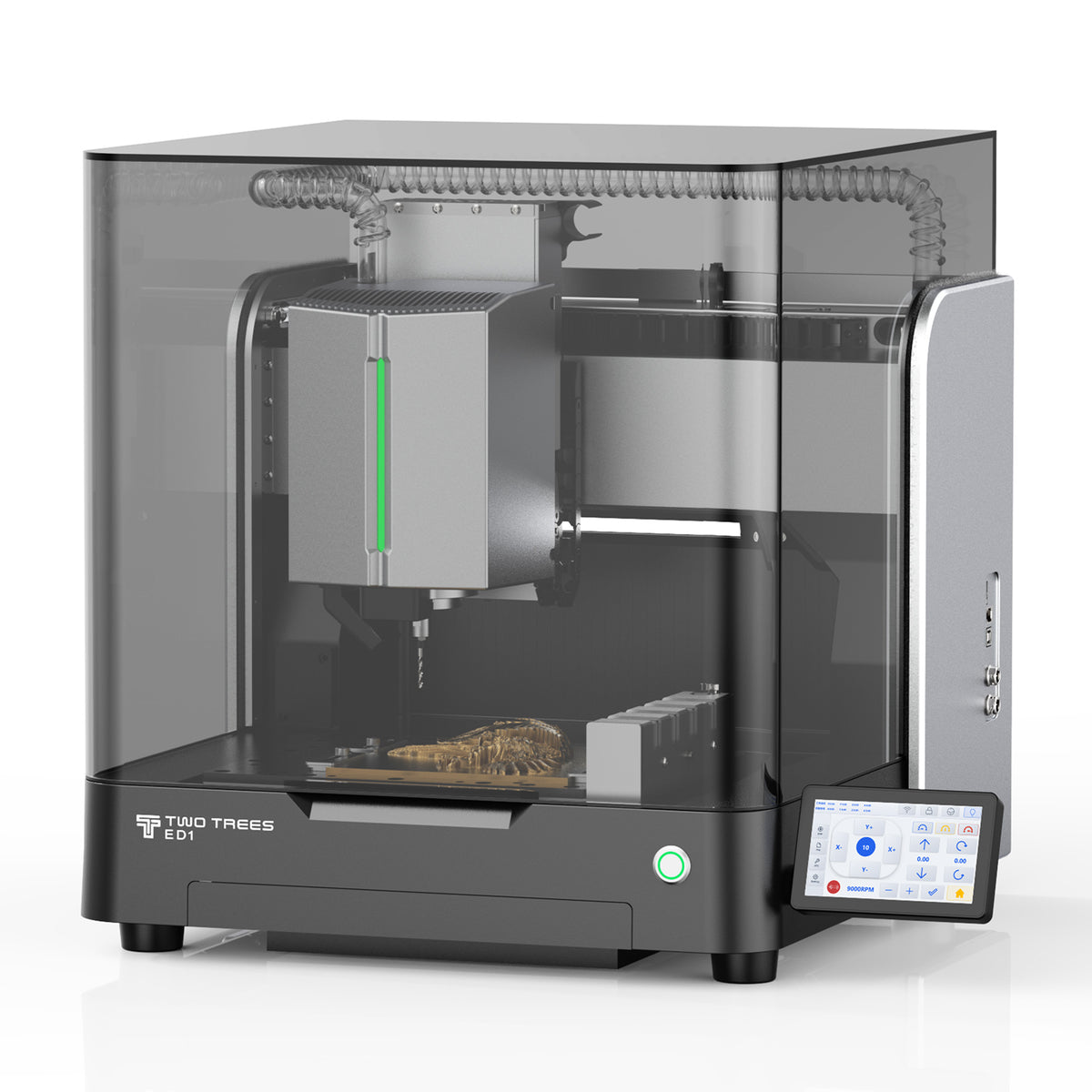
The ED1 enclosed desktop CNC router is a platform to evaluate for accessible small-part and prototype work. Its enclosure and machine features do not qualify a particular replacement design. Match the actual material, cutter, stock, and fixture to the machine's current instructions rather than treating the product category as a guarantee that every metal or geometry is suitable.
The material name is only the beginning
“Plastic” and “aluminum” are not service specifications. A final decision needs the relevant grade, manufacturing condition, exposure, and geometry. Nor should a printed material and a machined stock material be treated as interchangeable merely because their names sound similar. Use the applicable supplier data and account for how the part is made and loaded.
For a decorative item, appearance and handling may control the choice. For a sliding guide, friction, wear, and mating clearance may dominate instead. If temperature or chemicals are involved, establish the actual exposure rather than relying on the fact that a material survived a short bench check. If these requirements are unknown, a successful fit does not resolve them.
Keep this workflow to genuinely low-consequence parts. Braking, lifting, pressure containment, electrical protection, machine guarding, and other safety-critical functions need the appropriate OEM solution or qualified engineering assessment. Changing from printed plastic to machined metal is not a substitute for that assessment.
Follow one replacement through both routes
Imagine a small decorative cover on a desktop organizer. This is a hypothetical example: it contains no electrical parts, carries no structural load, and has no guarding function. Two locating tabs are broken, a shallow recess clears a cable, and the outer face is curved.
If the tab engagement is unclear, first model only the tabs and enough surrounding material to hold their relationship. A printed fitting model lets you check the sockets and cable clearance without committing to the finished appearance. Revise the geometry if it binds or leaves an unintended gap. Do not infer a final material's durability from this fitting step.
If preserving the curved face and integral tabs is important, an additive final route may be worth evaluating against the actual material requirements. If the design can instead become a flat cover with accessible holes and an open recess, machining suitable stock may be practical. This is a design change, so check the mating assembly again rather than assuming the old fit result still applies.
A combined workflow need not mean machining a fragile printed prototype. It can simply mean using the print to resolve geometry, then producing a separate final part in an appropriate stock material. If the proposal really does involve machining a printed component, the printed structure, fixture, cutting approach, and service requirements need their own evaluation.
Compare the whole job, not only machine time
For one replacement, the fastest cutting or printing operation may not produce the shortest route to a usable part. Measurement, CAD changes, CAM preparation, stock preparation, supports, fixtures, repositioning, finishing, and inspection can dominate the work. The Stratasys comparison of printing and CNC machining discusses why process preparation and secondary operations matter alongside fabrication.
For the organizer cover, stop comparing once you can answer the controlling questions: do the interfaces fit, can the chosen process make the final geometry, and is the selected material appropriate for the actual use? Print first if it resolves an uncertain interface. Machine when accessible features and suitable stock make that route credible. If the service requirement remains unknown, neither a clean print nor a polished machined surface closes the gap.