Preventing CNC vise jaw marks starts with deciding where the jaws will touch and what those surfaces must become. A contact mark on rough stock that will legitimately be removed later is a different problem from a mark on a finished display face or a surface that locates another component. Reducing clamping force or adding an unspecified soft layer does not resolve that difference—and neither helps if the change compromises the hold.
The important decision is therefore made before the final surface is cut: identify the contact region for the current operation, its finished requirement, and the region that will support the next operation. A secure first setup can still create an appearance problem when the same part is gripped again.
Why a Secure Grip Can Still Leave Marks
Holding a part in place and preserving its surface are related, but they are not the same requirement. A jaw can retain the workpiece while its contact leaves a localized impression. A chip trapped between the jaw and the part can scratch the face or create a concentrated pressure point. An unsupported thin feature presents another problem: the part can change shape under the holding load even if it does not visibly slip.
Those possibilities should not be treated as interchangeable diagnoses. A narrow contact impression suggests a different contact problem from a scratch associated with trapped debris, while a distorted feature calls attention to support as well as gripping. The appearance of a defect alone is not enough to identify its cause on an unseen part. What matters for planning is recognizing that a firm hold does not automatically establish an acceptable finished surface.
Carr Lane’s fixture-material guidance discusses surface protection alongside material response, support and rigidity. Its useful general principle is that the contact must suit the part without sacrificing the stability needed for machining. That does not establish a universal clamping force or a protective-jaw specification for a desktop CNC.
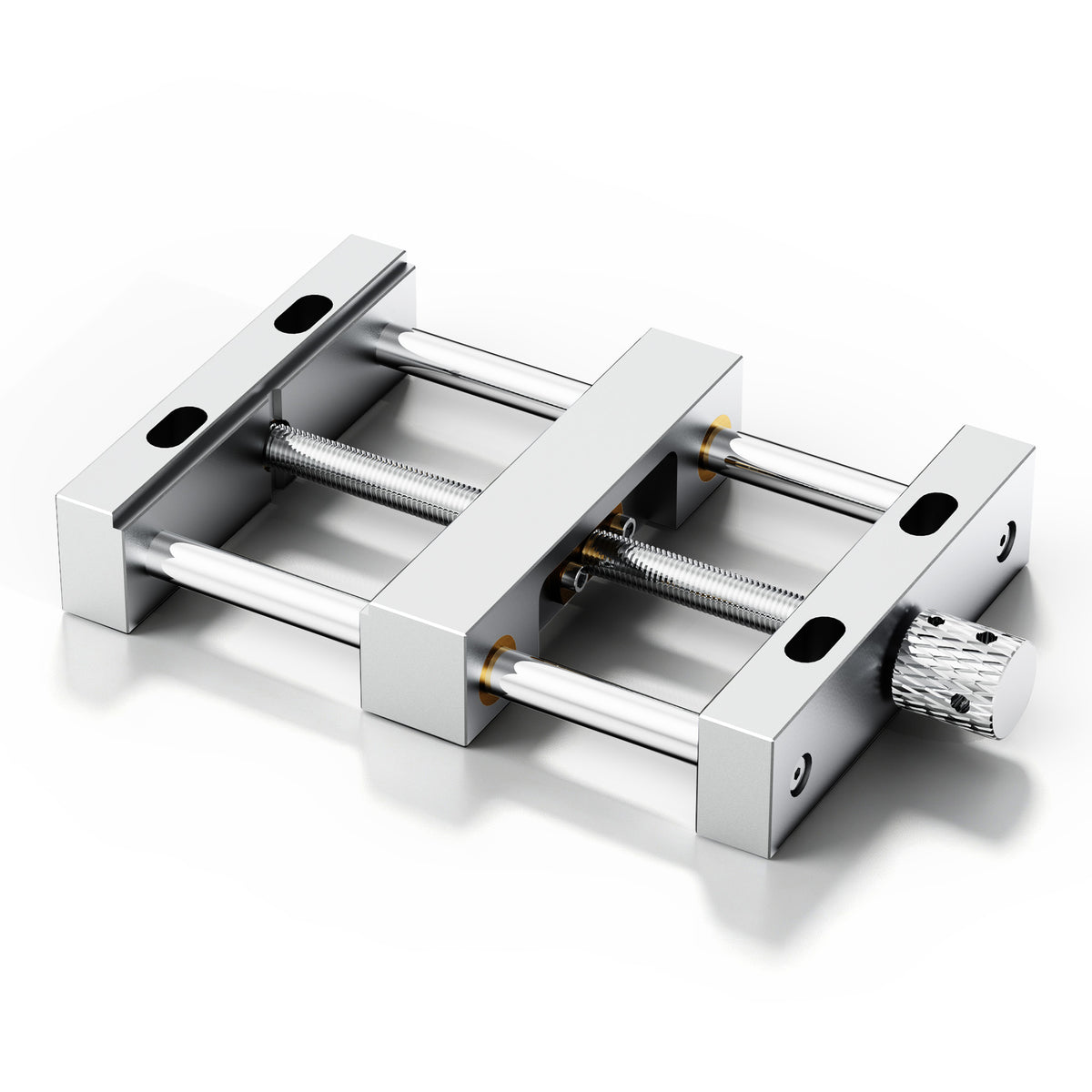
For an ED1 setup, the TwoTrees ED1 aluminum vise bench clamp is the dedicated side-gripping accessory for the ED1 desktop CNC router. Its jaws establish contact regions on suitable compact blanks. Choosing those regions is part of the workholding plan; the presence of the vise is not a guarantee that a particular visible face will remain unmarked.
Clean contact matters before considering a different jaw material. Debris at the interface can change how the part seats as well as what happens to its surface. Stop and isolate the machine according to its manufacturer’s procedure before inspecting or cleaning the contacts. Do not reach into an operating enclosure, wipe moving stock or use compressed air to scatter the debris. Cleanup should restore the intended seating arrangement, not merely improve what can be seen from outside.
Which Contact Surfaces Are Allowed to Change?
A rough region is only sacrificial when the design actually permits material to be removed from it and a later supported operation can perform that removal. Calling a side “unfinished” does not make every jaw mark harmless. If that side is already at its required size, or if removing the damaged region would leave too little material for the finished feature, there may be no legitimate cleanup allowance.
A cosmetic face has an appearance requirement. A locating, mating or sealing face has a functional requirement that may not be obvious from a photograph. For example, a side face used to position a small part against another component is not disposable simply because it sits out of sight. Sanding away a visible mark can change that locating relationship. A repair that improves appearance may therefore make the part less suitable for its intended assembly.
This distinction also changes what “protecting the finish” means. A visible impression in stock that will be cut away is a process-planning issue. The same impression on a final mating face can be a part-acceptance issue. Neither can be resolved by assuming that polishing will restore the original geometry. Establish what the surface must do before deciding whether it can become a jaw contact.

One Presentation Part, Two Different Gripping Decisions
Consider a hypothetical small engraved presentation part with a visible top and two side faces that will eventually receive their final appearance. This is a planning example, not an ED1 machining trial or a validated fixture. During the first operation, suitable rough side regions provide grip while the top remains accessible. At this stage, those side contacts may be acceptable if their contacted material can be removed later without violating the design.
The important word is later. The maker must already have a viable way to support the part when those sides are finished. If the first operation removes every useful alternative gripping region, the original contact plan has created a problem for the next setup. A final side-finishing pass is not a complete solution when no suitable hold remains to carry it out.
Now suppose the sides have been brought to their required appearance and size, but a feature on another face still needs machining. Regripping the same sides no longer means contacting disposable stock. The jaws would touch final surfaces. Whether those sides are decorative or locate the part in an assembly changes the consequences of an impression, scratch or seating change.
This is why a part can emerge from its first operation looking good and still be poorly planned for completion. The first setup answered how to hold the blank, not necessarily how to hold the partly finished part. A region that was useful because it contained extra stock may disappear; a region that remains may become too important to treat as an ordinary contact surface.
The next gripping decision must account for the cut still to be made, the support the part now needs, and the faces that must remain unchanged. Do not assume that a protective layer makes the original grip reusable. If that layer changes seating or allows movement, it can affect the reference used for the remaining feature as well as retention. A pleasant-looking contact material is not, by itself, a complete workholding design.
Finishing Order Only Helps if the Next Setup Still Works
Leaving a contacted region unfinished until it is no longer needed can be useful, but “finish every face last” is not a universal machining sequence. A later operation may require a surface that an earlier cut removes. It may leave a wall thinner and less able to tolerate the former holding arrangement. Or it may need a reference whose relationship to the fixture changes when the part is turned and seated again.
A different order must therefore solve a specific dependency. If the rough side region is the only viable contact for the top operation, preserve it until that operation is complete. If finishing that region leaves no suitable hold for the remaining work, moving the finish to a later point has not solved the problem. The part design, contact arrangement or process may need to change before material is cut.
Protective contacts and soft jaws are general engineering options, not automatic answers. An appropriately designed contact can provide support or avoid an unsuitable contact surface, but softness alone does not establish rigidity, secure retention or a repeatable reference. Use only hardware and procedures appropriate to the exact machine and fixture; do not infer ED1 compatibility from a generic jaw cover or another vise’s illustration.
Likewise, lowering force is only meaningful within a holding arrangement that still resists the actual machining load. It should not become a cosmetic adjustment made without understanding the retention requirement. A part that can move is not an acceptable trade for an unmarked face. If the proposed contact cannot preserve the final surface while retaining and supporting the part, it is the setup that needs reconsideration.
Before committing to a finish, establish the next viable contact—not just the next toolpath. The presentation-part example is resolved only when the remaining features can be machined with suitable support and without treating final faces as disposable. Where no such arrangement exists, revise the process or design while those choices are still available, rather than discovering the conflict after the usable gripping material has gone.